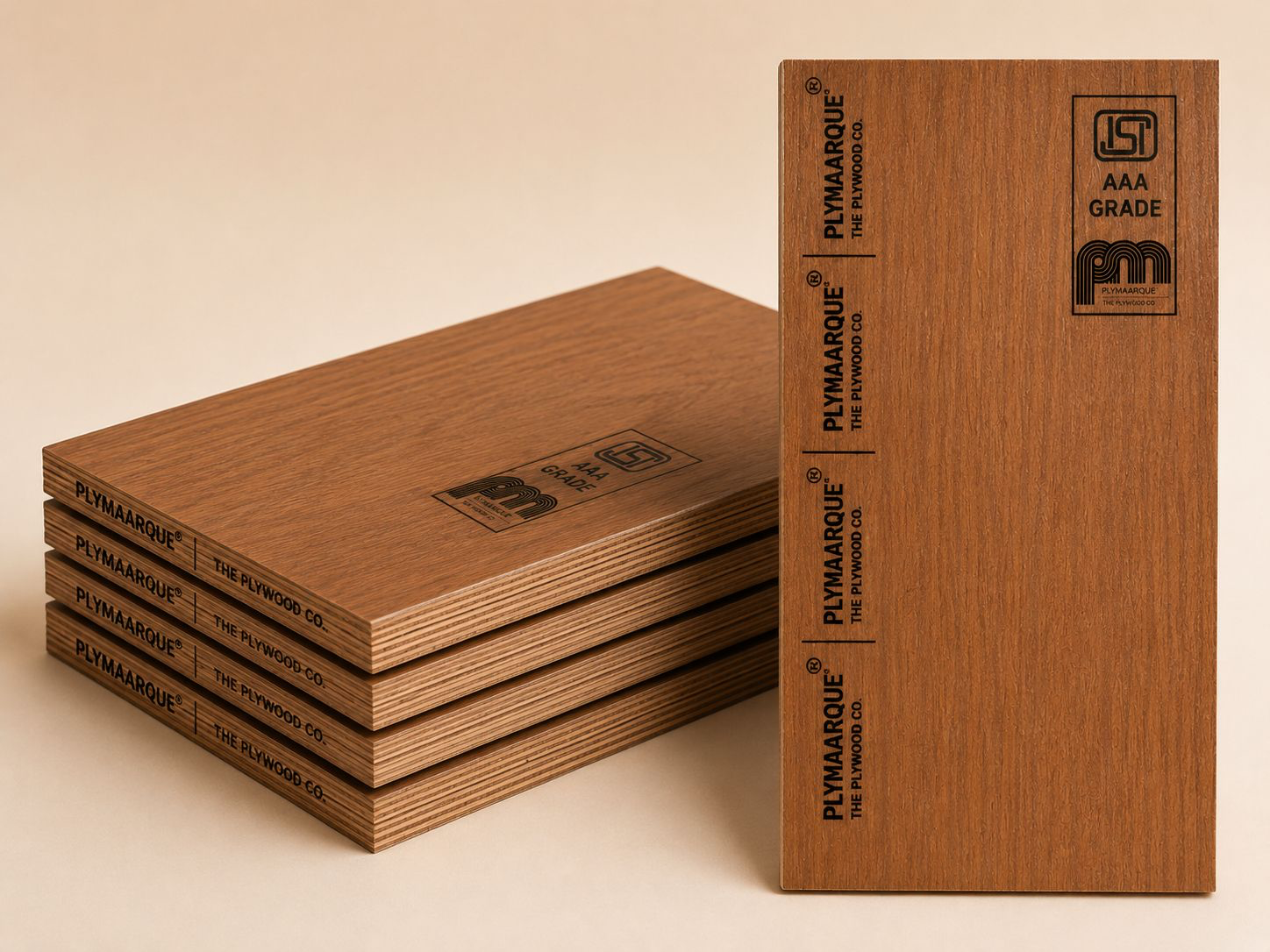
Tropical climates are unkind to ordinary plywood. Eight months of dry heat followed by four months of saturated monsoon air is a punishing cycle — one that exposes every shortcut taken inside a sheet. For architects designing across India's coastal cities, hill stations and humid plains, plywood selection is not a finish decision. It is a structural one.
Why Tropical Climates Demand More From Plywood
Heat expands. Humidity swells. Salt-laden coastal air corrodes adhesives. A sheet that performs flawlessly in a Delhi winter showroom may delaminate within a single Mumbai monsoon. The challenge is not the worst day of the year — it is the constant cycling between extremes, day after day, season after season.
Premium plywood for tropical India must hold its calibration through 95% relative humidity, resist fungal attack in unventilated wardrobes, and refuse to warp when one face faces the sun and the other faces an air-conditioned interior. Very few sheets in the market actually clear that bar.
BWP Grade — The Only Honest Starting Point
Boiling Waterproof Plywood, bonded with phenol-formaldehyde resin under high pressure, is the baseline for any tropical specification. BWP is engineered to survive submersion — and that is exactly the test a kitchen base unit, a bathroom vanity, or a coastal wardrobe quietly endures every year. MR and BWR grades belong in dry, controlled interiors, never in zones exposed to vapour or coastal air.
“In a tropical climate, the adhesive system matters more than the face veneer. The surface fails second. The bond fails first.”
Moisture Resistance — Reading Beyond The Stamp
- IS:710 marine-grade certification for any wet or coastal application
- Phenolic bonding visible as a dark, uniform glue line at the edge
- Hardwood core species — gurjan, eucalyptus or keruing, never softwood
- Calibrated thickness with tolerance under 0.3mm across the sheet
- Edge sealing recommended on every cut before installation
Durability Metrics That Actually Matter
Density is the quiet predictor of longevity. A premium tropical-grade sheet weighs noticeably more than a commercial equivalent of the same thickness — denser cores hold screws longer, resist warping under hinge load, and shrug off the daily swing between humid morning and dehumidified afternoon. Ask for the kilograms-per-cubic-metre number. A confident manufacturer answers in seconds.
Equally critical is dimensional stability under cyclic humidity. The IS:710 72-hour boil test is non-negotiable for coastal Mumbai, Chennai, Goa, Kochi and Kolkata. Inland tropical cities — Bengaluru, Hyderabad, Pune — can specify IS:303 BWR for dry joinery, but every wet zone still demands marine.
Specification By Zone
- Coastal homes — marine BWP throughout, including bedroom wardrobes
- Kitchens and bathrooms anywhere in India — marine BWP, no exceptions
- Hill-station projects — BWP for monsoon-facing walls, BWR for interiors
- Apartment dry joinery — first-grade BWR with edge sealing
- Outdoor pergolas and louvres — WBP exterior-grade with UV-stable finish
“Specify for the worst week of the monsoon, not the average week of the year.”
The Plymaarque Tropical Standard
Every sheet we stock for tropical specification is tested against three quiet benchmarks — a 72-hour boil cycle, a humidity-chamber swelling test, and a long-term screw-retention check after moisture exposure. We refuse what looks acceptable on a showroom floor but fails inside a closed wardrobe in July. For architects designing across India's coast, hills and humid plains, this is the standard your interiors deserve.
The Plymaarque Perspective
Every material we curate is chosen for one reason — to help architects, designers and homeowners build interiors that endure. Trends fade. Specification choices, made well, become the quiet luxury that defines a home for decades.
“Luxury is not what you add at the end. It is what you specify at the beginning.”
— Plymaarque Atelier

Conversation
Loading…